Brand impersonation account takeover (ATO) happens when attackers use fake brand assets to expose customers, harvest credentials, and attempt access on the legitimate site. The impersonation stage happens outside the enterprise’s login environment, but the ATO risk appears when stolen credentials, attacker devices, or exposed users reach the legitimate login environment.
That distinction matters because brand impersonation and account takeover are often handled as separate problems. Brand teams focus on fake domains, spoofed sites, malicious ads, and takedown. Fraud and security teams focus on login risk, credential misuse, and account access. Attackers exploit the space between those workflows.
Brand impersonation is not the only path to ATO. Remote access attacks, AiTM attacks, infostealer malware, and dark web credential purchases can also lead to ATO. Not every brand impersonation attack becomes account takeover either. This article focuses on one specific path: the impersonation-led ATO chain, where fake brand exposure progresses into credential harvesting and login or account access attempts.
The risk is not only that a fake site exists. The risk is that the fake site becomes the first observable stage of an ATO attempt.
TL;DR
- Brand impersonation attacks frequently serve as the entry point to account takeover campaigns.
- Attackers use fake websites, fraudulent ads, spoofed domains, and other impersonation tactics to expose customers and collect credentials.
- The resulting account takeover attempt may occur hours, days, or weeks later, making the two events appear unrelated.
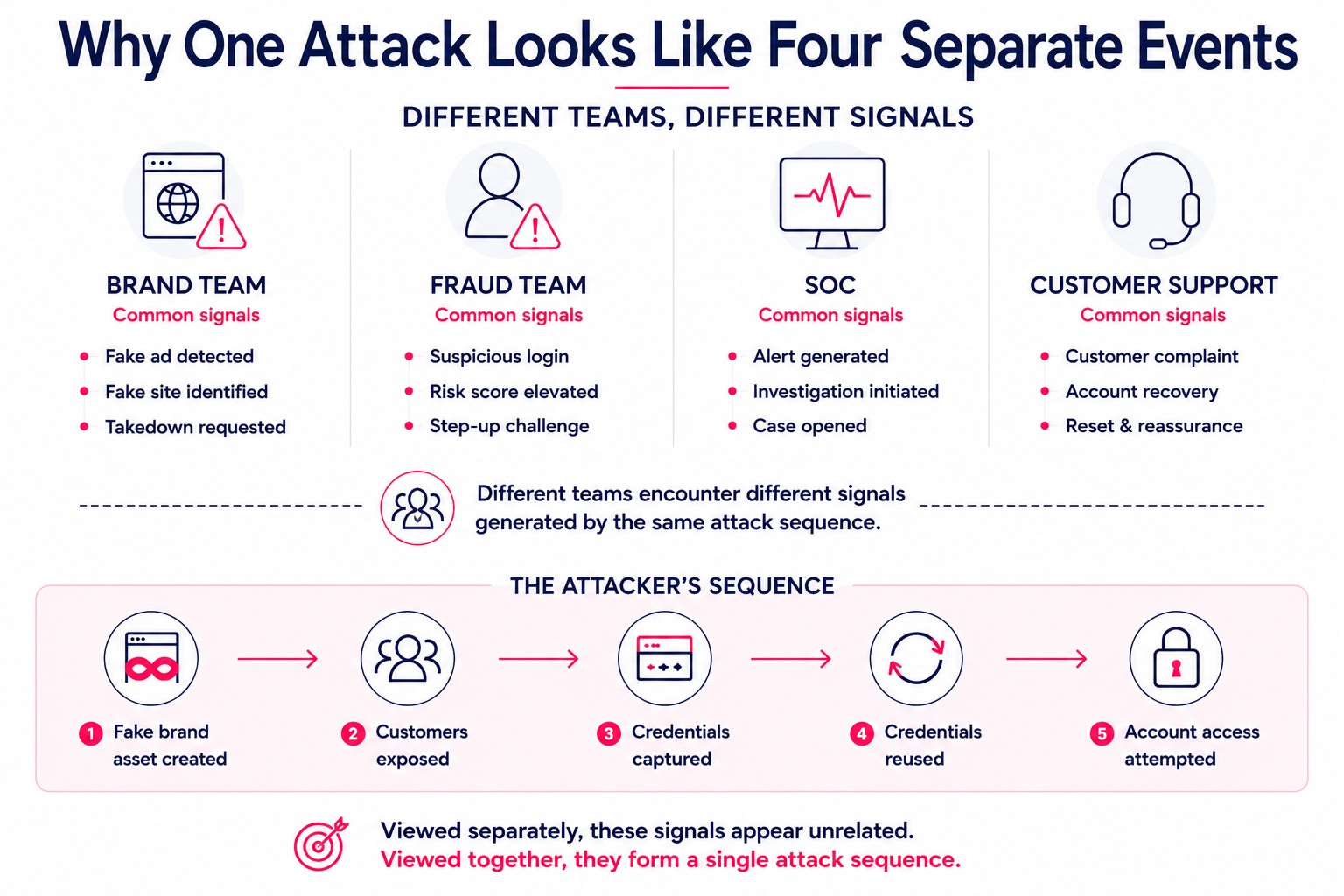
- Different teams often see different signals, including fake sites, suspicious logins, security alerts, or customer complaints.
- Viewing these signals as part of a connected attack sequence helps organizations identify risk earlier and respond more effectively.
- Account takeover can occur through multiple paths, but phishing-led brand impersonation remains one of the most common routes.
How Brand Impersonation Leads to Account Takeover
Brand impersonation becomes an account risk problem when fake brand assets are used to capture credentials or push customers into a spoofed login flow.
Most security teams are familiar with the visible parts of brand impersonation detection. Attackers register lookalike domains, clone brand pages, buy fake search ads, manipulate search results, or create fake social profiles and mobile apps. Those assets damage trust, divert traffic, and create customer confusion.
But in many campaigns, the fake brand asset is not the end goal. It is the delivery layer.
A fake banking login page, a spoofed airline loyalty portal, or a counterfeit retail account page is often designed to collect valid credentials. Once credentials are harvested through the impersonation flow, the attack can move from the external impersonation environment to the legitimate login environment.
That is the point where the problem changes category. What started as a brand protection issue becomes a customer account risk issue.
APWG observed 1,130,393 phishing attacks in Q2 2025, up 13% from Q1 2025, with 345 brands targeted in June alone. In Q4 2025, APWG observed 853,244 phishing attacks, with total 2025 phishing volume reaching approximately 3.8 million attacks. These numbers show why treating impersonation as a slow-moving brand abuse queue is increasingly risky.
What Is the Exposure-to-ATO Chain?
The Exposure-to-ATO Chain is the sequence where a user’s interaction with a fake brand asset leads to credential harvesting, credential reuse, and attempted account takeover on the legitimate site.
In impersonation-led attacks, account takeover is not a standalone event. It is the outcome of a sequence that begins with customer exposure and progresses through credential harvesting and reuse.
| Stage | What happens | What teams usually see | What they often miss |
|---|---|---|---|
| 1. Brand impersonation asset appears | A fake site, ad, profile, or app imitates the brand | Spoofed domain, cloned page, malicious ad, fake listing | Whether real customers are already exposed |
| 2. User reaches the fake experience | The user interacts with the impersonation asset | Traffic to suspicious infrastructure, complaints, reports | Which individual users interacted |
| 3. Credentials are harvested | The fake flow captures login data, OTPs, or sensitive details | Phishing indicators, stolen credential risk | Whether the data is now usable against the real site |
| 4. Credentials are reused | Attackers attempt access on the legitimate site | Login attempts, device context, credential use | Whether the login is connected to prior exposure |
| 5. Login-stage ATO risk escalates | Account access may be attempted or achieved | Suspicious login pattern detection, unknown device login detection | The full chain from fake brand exposure to login risk |
Many defenses can detect individual stages of the attack, but struggle to preserve the sequence that connects impersonation exposure to account access risk.
Key indicators include:
- A fake or lookalike brand asset designed to attract real customers
- Credential capture through a spoofed login or phishing flow
- Reuse of harvested credentials against the legitimate site
- Login attempts from devices, sessions, or contexts linked to prior exposure
Breaking the Account Takeover Attack Chain
This short video illustrates why organizations often encounter only fragments of an attack sequence and why earlier visibility can be critical to reducing account takeover risk.
Where Current Controls Lose the Sequence
The issue is not the absence of signals, but when those signals are evaluated.
Takedown workflows can identify and remove fake domains, but they often operate after exposure has already begun. Authentication controls can evaluate a login attempt, but they may not know the user was previously exposed to impersonation infrastructure. Fraud and risk systems can evaluate account risk, but they may lack the external exposure context that explains why a login attempt should be treated differently.
This creates a practical control gap.
A fake site may be discovered by a brand protection tool. A risky login may later be evaluated by an authentication or fraud system. But unless those events are connected, the enterprise is forced to evaluate the login as if it appeared from nowhere.
That is exactly where attackers benefit. They do not need every fake site visitor to convert. They only need enough exposed users to submit credentials, and enough of those credentials to work before the enterprise connects the exposure to the account.
Most controls are optimized for the wrong stage of the problem. They either focus on removing the impersonation asset or challenging the login attempt, but the decisive risk often sits between those two moments.
Why Timing Matters in Phishing-Led Account Takeover
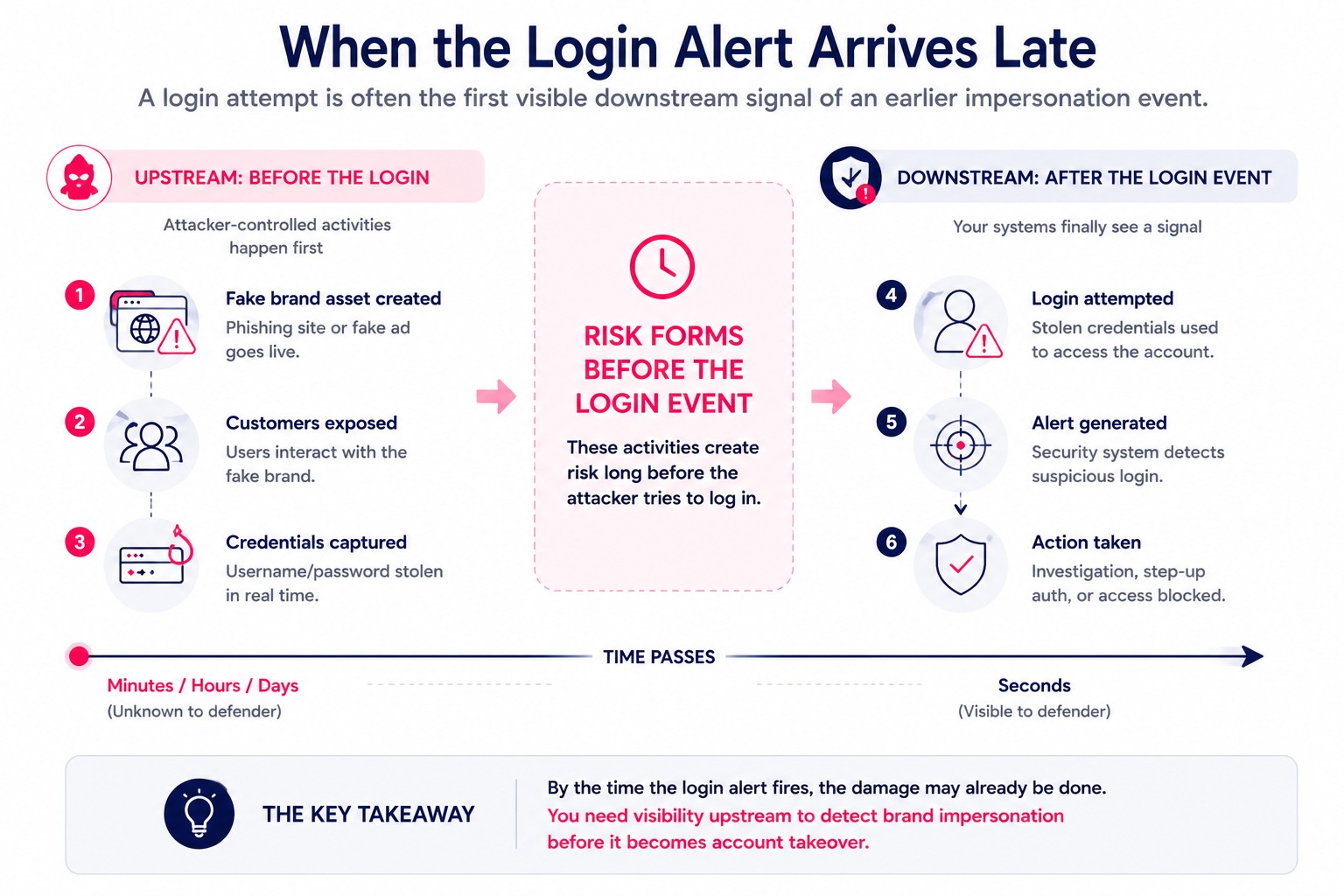
Timing matters because ATO risk increases before the attacker reaches the legitimate login page.
There are four windows to consider:
- The exposure window, when customers interact with fake brand assets.
- The credential capture window, when credentials or OTPs may be collected through impersonation infrastructure.
- The credential reuse window, when attackers test or replay what they captured.
- The authentication decision window, when the legitimate site decides whether to allow, challenge, or block a login or access attempt.
Most enterprises are strongest at the final window. They evaluate access when a login attempt occurs. That is necessary, but it is late in the chain.
A login attempt is not the beginning of phishing-led account takeover. It is often the first point where the enterprise can see the downstream result of an earlier impersonation event.
ENISA’s 2025 Threat Landscape reported that phishing remained a primary method for initial intrusion and was used for credential theft, session hijacking, payload deployment, and command execution. The same pattern applies in customer-facing fraud: phishing and impersonation are often the access preparation layer, not just the visible scam.
The timing problem becomes sharper when the credentials are valid. If the attacker arrives with a real username, password, and OTP, many controls are forced to make a decision with incomplete context. Without exposure history, device continuity, decoy credential signals, or referral context, the login may look like an isolated access event.
The evaluation question changes from “Is this login risky?” to “What happened before this login that changes how we should evaluate it?”
What Security and Fraud Teams Need to Connect
Security and fraud teams need to connect external impersonation signals with legitimate-site access signals.
That does not mean every brand impersonation event should be treated as confirmed account takeover. It means impersonation exposure should become part of account-risk evaluation when the customer, credential, device, or session later interacts with the legitimate site.
Practical signals include:
- Spoofed domain detection
- Website cloning attempt detection
- Traffic from suspicious or low-reputation domains
- Real-time phishing site warnings
- Detection of stolen or decoyed credentials in use
- Unknown device login detection
- Suspicious login pattern detection
- Login attempts blocked due to high-risk context
Detection quality depends not only on which signals are available, but on whether they can be evaluated in the order the attack unfolds.
For example, a customer visit from a low-reputation referral may not justify a severe response alone. An unknown device login may not prove compromise alone. A credential reuse event may not show the original exposure alone. But when those conditions appear in sequence, they provide materially different risk context than any individual signal alone.
This is where brand protection, SOC, fraud, and digital risk workflows need a shared operating model. Brand impersonation is the upstream signal. ATO is the downstream risk. The connection between them is where earlier intervention becomes possible.
What Should Security and Fraud Leaders Do Differently?
Security and fraud leaders should evaluate brand impersonation as part of the ATO lifecycle, not as a separate abuse queue.
The wrong question is:
“Did we find and remove the fake site?”
The better question is:
“Which customers were exposed, what account access risk may now exist, and how should that influence our response?”
That question creates a different control model. It forces teams to treat impersonation exposure as an account-risk signal, not only a brand-risk signal.
This is especially important for financial institutions, airlines, retailers, and digital platforms where customer accounts contain stored value, payment methods, loyalty balances, personal data, or access privileges. In these environments, the cost of impersonation is not limited to reputational damage. It can become ATO, fraud loss, support burden, customer distrust, and regulatory exposure.
The DOJ reported in 2025 that a bank ATO fraud scheme involving fraudulent search ads and spoofed banking experiences generated more than 5,100 complaints and more than $262 million in reported losses since January 2025. That case reflects the sequence this blog is describing: fake brand entry points, credential theft, and downstream account abuse.
The operating principle should change: ATO risk should be evaluated from the point of exposure, not only from the point of account access.
How Memcyco Helps Close the Exposure-to-ATO Gap
Memcyco helps enterprises connect impersonation exposure and downstream account access risk in real time, so teams can act earlier in the attack chain.
Its role is not to treat every ATO case as an impersonation case. Infostealers, remote access attacks, AiTM flows, and dark web credential purchases can create account takeover risk through other paths. Memcyco’s value in this scenario is connecting the impersonation-led path more clearly, from fake brand exposure to indicators of credential misuse and login risk.
In this context, Memcyco’s role is focused on impersonation exposure, credential-use indicators, device context, and login-stage risk signals.
Memcyco helps surface and correlate signals such as website cloning attempts, spoofed domains, low-reputation referral patterns, fake-site exposure, decoy credential use, unknown device login attempts, and suspicious login patterns. These signals can enrich fraud, risk, SOC, SIEM, and authentication workflows with pre-login and login-stage context.
Attackers already connect exposure, credential harvesting, and credential reuse into a single workflow. Defenses are most effective when they evaluate the same sequence rather than isolated events.
When a customer interacts with a fake brand asset, that exposure should not disappear into a takedown queue. When stolen or decoyed credentials later appear at the real login, that event should not be evaluated as a standalone login attempt. When a risky device is associated with the sequence, teams should be able to respond with more confidence and less delay.
The Exposure-to-ATO Chain turns brand impersonation from an external abuse issue into an account-risk signal that can be acted on earlier.
See How Memcyco Connects the Events Your Teams See Individually
If brand impersonation is treated only as a takedown problem, teams miss the moment where exposure becomes account risk.
That delay gives attackers room to move from fake brand assets to credential harvesting to legitimate-site access attempts.
Memcyco helps enterprises connect fake-site exposure, credential-use indicators, and login-stage account access risk in real time, so security and fraud teams can act earlier in the ATO attack chain.
See how Memcyco connects brand impersonation to ATO prevention
Or book your Memcyco demo to discover how Memcyco performs in different attack scenarios you may be facing, known and unknown.
Related Reading
- How to Detect Brand Impersonation: Key Signals for Security Teams
- Fake Search Ads and Brand Impersonation: Why Takedown Alone Misses the Real Risk
- Brand Impersonation Protection vs Domain Takedown: What Security Teams Actually Need
FAQs
What is the connection between brand impersonation and account takeover?
Brand impersonation can lead to account takeover when attackers use fake brand assets to capture customer credentials and then reuse them on the legitimate site. The fake asset creates exposure, while the account takeover attempt appears later in the real login environment.
Does every brand impersonation attack lead to account takeover?
No. Some impersonation attacks aim to steal payments, distribute malware, damage trust, or redirect customers without taking over accounts. This article focuses only on the impersonation-led ATO path, where fake brand exposure progresses into credential harvesting and login or account access attempts.
Is brand impersonation the same as phishing?
No. Brand impersonation is the misuse of a trusted brand’s identity across fake sites, ads, apps, profiles, messages, or domains. Phishing is one attack method that may use brand impersonation to trick users into sharing credentials or sensitive information.
Why are takedowns not enough to prevent account takeover?
Takedowns reduce impersonation infrastructure, but they do not always show which users were exposed before removal. If credentials were harvested before removal, account takeover risk can continue after the fake site is taken down.
What should enterprises look for in a solution for brand impersonation account takeover risk?
Enterprises should look for controls that connect impersonation detection with downstream account-risk evaluation. Useful capabilities include spoofed domain detection, website cloning detection, fake-site exposure visibility, decoy credential detection, unknown device login detection, and integration with fraud or SOC workflows.
How can security and fraud teams connect impersonation detection with ATO prevention?
They can treat impersonation exposure as an account-risk signal. When a user, credential, device, or session linked to fake-site exposure later interacts with the legitimate site, that context should influence login-stage detection, step-up, blocking, authentication, or investigation decisions.